
Waiting for Lower Mortgage Rates in Puget Sound? The August 2026 Forecasts Just Moved the Wrong Way
Quick answer: The 30-year fixed averaged 6.66% for the week ending August 27, 2026, per Freddie Mac. In August, both Fannie Mae and the Mortgage Bankers Association revised their 2027 forecasts upward, and neither now projects rates below 6.5% at any point through the end of next year. If your plan is to wait out the rate, the current forecasts do not support it. Meanwhile, inventory across King, Snohomish, Pierce, and Kitsap counties is up sharply, and Snohomish County prices are down 6% year over year. That combination is the leverage buyers actually have right now. Condo buyers have a separate issue: new Fannie Mae and Freddie Mac review rules took effect August 3, 2026.
Where mortgage rates stand today
Freddie Mac's Primary Mortgage Market Survey put the 30-year fixed at 6.66% for the week ending August 27, 2026, up slightly from 6.65% the week before. A year earlier, the same survey read 6.56%. Rates are higher than they were last summer, not lower.
The more instructive number is what happened in between. Rates ended 2025 near 6.15%, then fell to 6.01% in mid-February 2026, the lowest reading since September 2022. Anyone in Everett, Bellevue, Tacoma, or Silverdale who saw February and decided to hold out for something starting with a five is now shopping at 6.66%.
That is the real risk in waiting. It is not that rates will spike. It is that the window you were waiting for may already have been the window.
What the 2027 forecasts actually say
Three of the most-watched forecasters published updated numbers in August 2026:
Forecaster | Q4 2026 | 2027 |
|---|---|---|
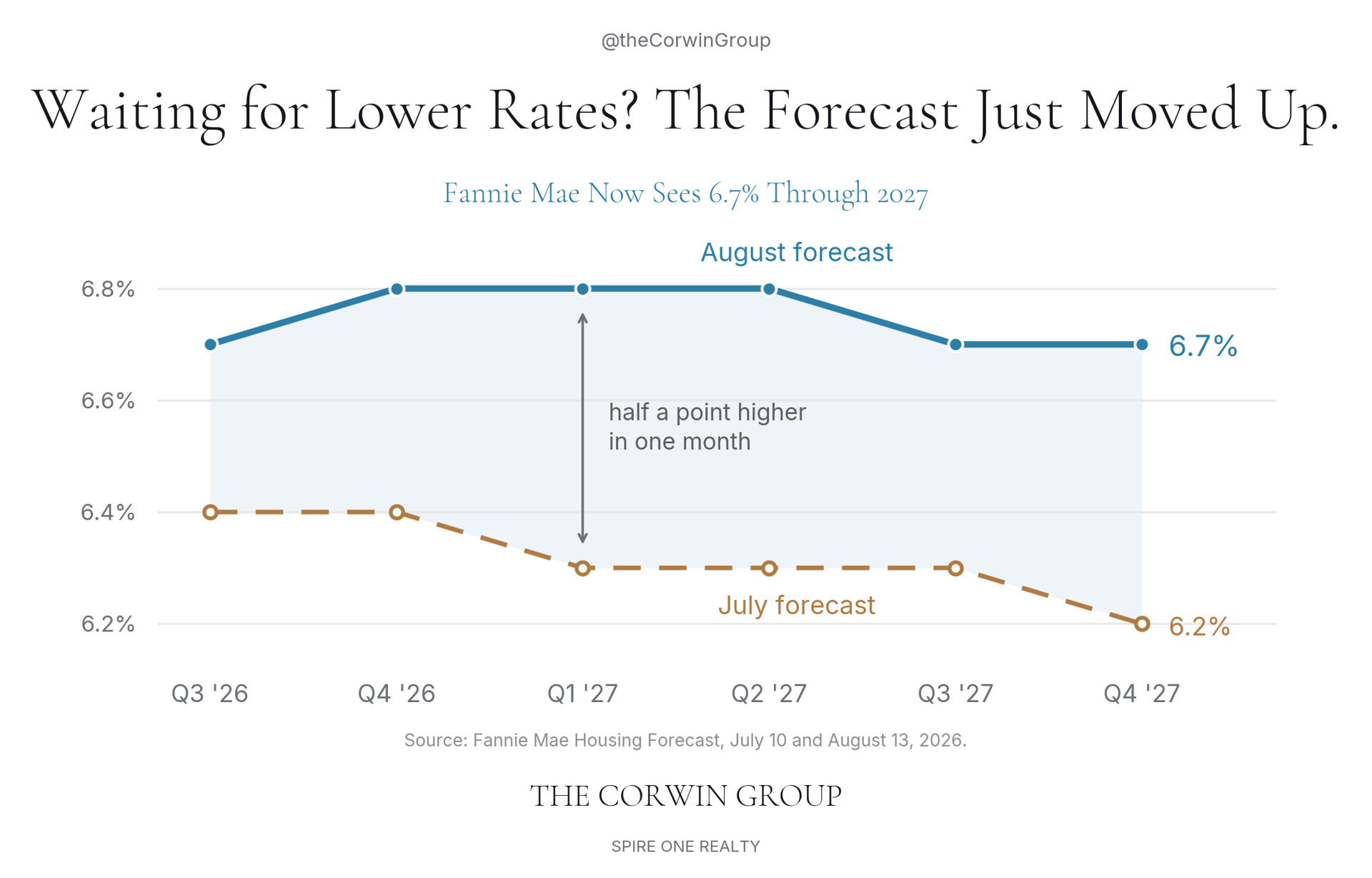
Fannie Mae | 6.8% | 6.8% first half, 6.7% second half |
Mortgage Bankers Association | 6.7% | 6.7% |
Wells Fargo | 6.4% | 6.35% Q1, 6.3% remainder |
Two details matter more than the numbers themselves.
First, the direction of revision. Fannie Mae's January 2026 forecast called for roughly 6% across both 2026 and 2027. Its August forecast is nearly a full point higher. The MBA moved up as well. These are not forecasters inching toward relief. They are backing away from it.
Second, what got revised away. Fannie Mae's July outlook still showed rates easing into 2027. The August revision removed that decline entirely. For buyers telling themselves they will simply refinance in a year or two, there is currently no major forecast underwriting that plan.
Rates are driven by inflation, Treasury yields, and Federal Reserve policy. The 30-year Treasury yield reached 5.31% on August 17, 2026, its highest level since 2007, pushed there by heavy government borrowing and inflation that has stayed above the Federal Reserve's target. Mortgage rates track long-term Treasury yields closely, which is the mechanical reason the forecasts moved. None of that resolves on a schedule that fits a house hunt.
What the local market actually looks like
Here is where the regional picture gets more interesting than the national one. Northwest Multiple Listing Service data for July 2026 across the four counties where most of my clients buy:
County | Median price | Change vs. July 2025 | Active listings | Change vs. July 2025 | Months of inventory |
|---|---|---|---|---|---|
King | $879,500 | +0.5% | 7,836 | +23.7% | 3.88 |
Snohomish | $719,000 | -6.0% | 2,878 | +34.7% | 3.01 |
Pierce | $575,000 | +1.7% | 3,174 | +17.2% | 3.04 |
Kitsap | $589,250 | +1.6% | 895 | +7.2% | 2.28 |
Seattle (city) | $884,500 | +0.6% | 2,700 | +14.4% | 3.96 |
A balanced market is generally four to six months of inventory. All four counties are still below that, so none of this is a buyer's market in the classic sense. Well-priced homes in Edmonds, Kirkland, Gig Harbor, and Poulsbo still move quickly.
But three things stand out.
Snohomish County is the outlier. It has both the largest inventory increase in the region at 34.7% and the only meaningful price decline among the four, down 6.0% from July 2025. If you are looking north of Seattle, this is the most negotiable market of the group by a clear margin.
Kitsap is the tightest. At 2.28 months, Kitsap has the lowest inventory of any county in the NWMLS service area, and inventory grew only 7.2% year over year. Buyers in Bremerton, Silverdale, and Bainbridge Island have meaningfully less leverage than buyers in Snohomish. Anyone relocating for the shipyard or Naval Base Kitsap should plan accordingly.
King is expensive but no longer frantic. Inventory is up 23.7% and pricing is essentially flat. Pending sales fell 13.5% year over year, which means competition has thinned even though prices have held.
That negotiating room is a function of inventory, not rates. And it is the first thing to disappear if rates fall and sidelined demand returns all at once. Buyers waiting for a better rate may be trading a position they have today for a bidding war they do not want.
What waiting actually costs, by county
Run it on real local numbers. Assume 20% down and compare today's 6.66% against the 6.00% many buyers are holding out for. Principal and interest only, excluding taxes, insurance, and association dues.
County | Median price | P&I at 6.66% | P&I at 6.00% | Monthly difference |
|---|---|---|---|---|
King | $879,500 | ~$4,521 | ~$4,218 | ~$303 |
Snohomish | $719,000 | ~$3,696 | ~$3,449 | ~$247 |
Pierce | $575,000 | ~$2,956 | ~$2,758 | ~$198 |
Kitsap | $589,250 | ~$3,029 | ~$2,826 | ~$203 |
That gap is the size of the bet. To win it, three things have to break your way at once. Rates have to fall roughly two-thirds of a point, which no major August forecast currently projects before 2028. The home you want has to still be there. And the price has to hold.
On a Snohomish County home that has already come down 6% year over year, that last condition is doing a lot of work. A buyer waiting for a $247 monthly savings could easily give back more than that in a price rebound if inventory tightens.
If you are buying a condominium, there is a new step
Condo financing changed on August 3, 2026. Fannie Mae retired its Limited Review process and Freddie Mac eliminated its Streamlined Review, which means most established projects above ten units now require a Full Review of the association's budget, reserves, insurance, litigation, and delinquencies before a conventional loan is approved. A larger down payment no longer bypasses it.
At the same time, condos are the softest segment in the region. Seattle condos reached 6.24 months of inventory in July 2026 at a median of $525,000, down 4.6% year over year, which is a buyer's market by the standard definition.
Better pricing and harder financing arrived in the same month. Before you write an offer on a condo, find out where the association stands on reserves, insurance, litigation, and delinquencies. Since August 3, that is what decides whether the loan happens.
Four ways to lower your payment without waiting for rates
1. New construction incentives
Builders across Marysville, Lake Stevens, Puyallup, Bonney Lake, and north Bothell are actively buying down rates, covering closing costs, and including upgrades. Forward commitments through a builder's preferred lender can deliver a rate materially below market.
Ask this directly: what is the incentive worth if I use my own lender? The number usually changes, and knowing by how much tells you what the preferred-lender rate is really costing you elsewhere.
2. Rate buydowns, permanent or temporary
A seller-paid buydown is frequently worth more to a buyer than an equivalent price reduction, and many sellers in this market will consider it.
On a $575,200 loan, a $10,000 price cut lowers the payment by roughly $64 a month. That same $10,000 applied to a permanent buydown can commonly reduce the rate by something in the neighborhood of 0.4%, cutting the payment closer to $160 a month. Buydown pricing changes daily and varies by lender, so treat that as an illustration and get a real quote. The structural point holds: at Puget Sound price points, dollars applied to the rate usually outwork dollars applied to the price.
A temporary buydown, often structured as 2-1, lowers your payment for the first two years and then steps up to the note rate. It helps a stretched first year. It does not help year three, so only use it if the note-rate payment already works.
3. Adjustable-rate mortgages
Worth asking about if you have genuine reason to believe you will move or refinance inside the fixed period. A military assignment at JBLM or Naval Base Kitsap, a planned relocation, or a starter condo you already expect to outgrow all qualify.
Ask your lender four specific questions: what index it is tied to, what the margin is, what the caps are at first adjustment and over the life of the loan, and what the worst-case payment looks like. If the worst-case payment does not work, the loan does not work.
4. Assumable mortgages, with the actual rules
You will see assumable loans presented as a simple way to inherit a seller's low rate. The real mechanics are narrower, and worth understanding before you go looking.
Only government loans are assumable. FHA, VA, and USDA loans can be assumed with lender approval. Conventional loans, which are the majority of what sold here during the low-rate years, generally cannot be. That alone eliminates most listings.
You have to cover the equity gap. You assume the remaining balance, not the purchase price. On a $719,000 Snohomish County home with $350,000 left on the seller's loan, you need roughly $369,000 in cash or a second lien to bridge the difference. Second liens carry current market rates, which erodes the benefit. This is why most assumptions do not pencil at Puget Sound prices.
For VA loans, the seller has real exposure. If a non-veteran assumes a VA loan, the seller's entitlement stays tied to that property until the loan is paid off, which can block the seller from using their VA benefit on their next purchase. A veteran buyer with available entitlement can substitute their own, releasing the seller. Given how many VA loans are in play around JBLM and Kitsap County, this comes up more here than in most markets, and it should be negotiated deliberately rather than discovered late.
Budget the time. Servicer approval on an assumption commonly runs 45 to 90 days, well outside a standard closing timeline, and it needs to be written into the contract.
Assumptions are a real tool. They are just a rare one, and the listings where they work get identified by searching loan type, not by hoping.
Frequently asked questions
Will mortgage rates drop below 6% in 2027? Based on August 2026 forecasts, no. Fannie Mae projects 6.8% through the first half of 2027 and 6.7% for the second half. The MBA projects 6.7% for all of 2027. Wells Fargo is the most optimistic of the three at 6.3% for most of 2027. None show a reading below 6%.
What is the current mortgage rate in Washington State? Freddie Mac's national survey read 6.66% for the week ending August 27, 2026. Your actual quoted rate will differ based on credit score, down payment, loan type, property type, and whether you are buying a condominium. VA and FHA loans typically price below conventional. Get a live quote rather than relying on a survey average.
Which Puget Sound county has the most negotiating room right now? Snohomish County, by a clear margin. As of July 2026 it had the largest inventory increase in the region at 34.7% and a median price down 6.0% year over year, the only meaningful decline among King, Snohomish, Pierce, and Kitsap. Kitsap was the tightest at 2.28 months of inventory.
What is the median home price in King County? $879,500 in July 2026, up 0.5% from July 2025. Within the county, the city of Seattle came in at $884,500 and the Eastside at $1,378,000.
Is it a good time to buy a condo in Seattle? Seattle condos reached 6.24 months of inventory in July 2026 at a median of $525,000, down 4.6% year over year. That is a buyer's market by the standard four-to-six-month definition, and the softest segment in the region. The complication is financing, which got harder on August 3, 2026.
What changed for condo financing on August 3, 2026? Fannie Mae retired its Limited Review process and Freddie Mac eliminated its Streamlined Review for conventional loan applications dated on or after that date. Established projects above ten units now require a Full Review of the association's finances. FHA and VA project approval processes are separate and are not governed by this change.
Can I assume a seller's mortgage in Washington? Only if it is an FHA, VA, or USDA loan, and only with servicer approval. Conventional loans are not assumable. You also need to cover the difference between the loan balance and the purchase price in cash or through a second lien, which is why most assumptions do not work at local prices.
The bottom line
Nobody has to buy right now. But "I'll wait for rates to drop" is a strategy, and strategies should be checked against evidence. The August 2026 evidence says forecasters are revising upward, not downward, and that the real advantage in this market is inventory rather than rates.
The useful exercise is not guessing where rates go. It is running your actual numbers on an actual home in the county you are actually shopping, comparing them against what waiting would need to deliver, and deciding from there.
If you are looking at condominiums, add one step: find out where the association stands before you write the offer. Since August 3, that question decides whether the loan happens.
I'm glad to run that math with you for any specific property or neighborhood in King, Snohomish, Pierce, Kitsap, or Island County.
Erin Corwin The Corwin Group at Spire One Realty Washington State Real Estate Broker, License #25008349 Serving Snohomish, King, Pierce, Island, Kitsap, and surrounding counties
Information and statistics compiled and reported by the Northwest Multiple Listing Service. Rate data from Freddie Mac's Primary Mortgage Market Survey as of August 27, 2026. Forecast data from Fannie Mae, the Mortgage Bankers Association, and Wells Fargo August 2026 releases. Treasury yield data as reported by Bloomberg and CNBC, August 2026. Condo project review changes per Fannie Mae Lender Letter LL-2026-03 and corresponding Freddie Mac bulletins. Payment figures are illustrations of principal and interest only and exclude taxes, insurance, and association dues.
I am a licensed real estate broker, not a mortgage lender, attorney, or tax advisor. Loan programs, rates, and qualification terms are determined by your lender. Consult appropriate professionals for lending, legal, and tax advice.
