
Quick answer: A rate buydown is money paid at closing, often by the seller, to lower a buyer’s mortgage interest rate. A temporary buydown (such as a 1-0 or 2-1) lowers the rate for the first one to three years. A permanent buydown uses discount points to lower it for the life of the loan. On an $800,000 Washington home with 5% down at 7.40% (about 7.50% APR; Freddie Mac’s average as of October 8, 2026), a $12,000 seller credit lowers the payment by about $79 a month as a price reduction, an estimated $203 a month as a permanent buydown, or about $508 a month in year one as a 1-0 buydown.
By Erin Corwin, Washington real estate broker, The Corwin Group at Spire One Realty. Published October 9, 2026.
Want to see these numbers on a home you’re considering or selling? Call or text Erin at 206-650-7390.
When rates rise, the conversation usually turns to price. But for a buyer, the number that decides whether a home works is the monthly payment. A rate buydown goes straight at that number, and dollar for dollar it often does far more than a price reduction.
The examples below use an $800,000 home with 5% down, a $760,000 loan, and a 7.40% 30-year fixed rate (about 7.50% APR; Freddie Mac’s weekly average as of October 8, 2026). The base payment is $5,262 a month in principal and interest.
How does a temporary rate buydown work?
With a temporary buydown, money paid at closing (often by the seller) lowers the buyer’s rate for the first one to three years. The note rate stays the same, and the payment steps up each year until it reaches the full payment.
Buydown | Year 1 payment | Year 2 payment | Year 3 payment | Approximate cost |
|---|---|---|---|---|
1-0 (1% off for one year) | $4,754 | $5,262 | $5,262 | $6,100 |
2-1 (2% off, then 1% off) | $4,268 | $4,754 | $5,262 | $18,000 |
3-2-1 (3%, 2%, then 1% off) | $3,806 | $4,268 | $4,754 | $35,500 |
A few rules to know on conventional loans, per Fannie Mae:
- The rate can be reduced by no more than 3%, and can rise by no more than 1% per year.
- The buydown period can’t exceed three years.
- The buyer must qualify at the full note rate, not the reduced one.
- Buydown funds from the seller count toward the seller contribution limit. With 5% down, that limit is generally 3% of the price, or $24,000 here. A 2-1 fits within it; a 3-2-1 would not.
Temporary buydowns work well for buyers who expect their income to grow, or who plan to refinance if rates fall. If they refinance early, unused buydown funds are typically credited toward the loan payoff.
How does a permanent buydown with discount points work?
A permanent buydown means paying discount points at closing to lower the note rate for the full term. Pricing changes daily and varies by lender, but a common rule of thumb is that one point (1% of the loan) lowers the rate by about 0.25%.
On our example, about 1.6 points (about $12,000) would bring the rate from 7.40% down to around 7.00% (about 7.27% APR with the points included), saving about $203 a month for as long as the buyer keeps the loan. It takes about five years for those savings to catch up to the cost.
Is a rate buydown better than a price reduction?
Most seller credits are well under the limit. Here is a $12,000 credit, 1.5% of the price, used three ways:
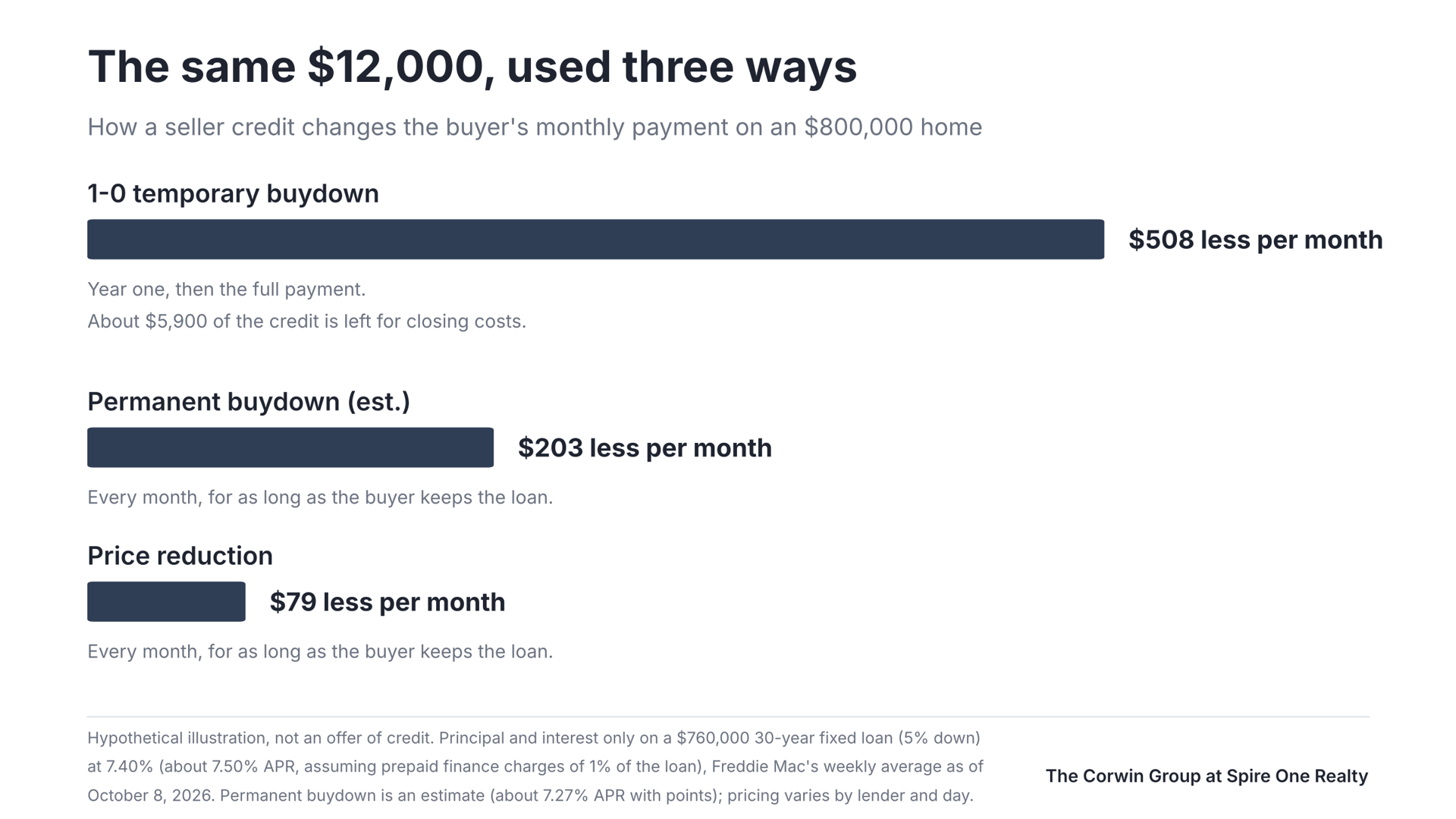
Seller gives $12,000 (1.5%) as... | Effect on buyer’s payment |
|---|---|
A price reduction | About $79 less per month, for the life of the loan |
A 1-0 temporary buydown | About $508 less per month in year one, with roughly $5,900 left for closing costs |
A permanent buydown (est.) | About $203 less per month, for the life of the loan |
Each $1,000 off the price saves this buyer less than $7 a month. The same $1,000 put toward the rate saves far more.
Which type of buydown is right for you?
- Planning to stay put for years? A permanent buydown can pay off over time.
- Expecting to refinance if rates drop, or expecting income to grow? A temporary buydown lowers the early payments without paying for years of rate reduction you may never use.
- Short on cash to close? Split the seller credit between a buydown and closing costs, and look at down payment assistance too.
For sellers, timing matters. A buydown credit works best when it’s offered from day one and featured in the marketing, or when it’s negotiated with a buyer who is already at the table. It won’t trigger the price-change alerts and fresh search activity that a price reduction does, so if a listing needs new attention, a credit is a complement to a price adjustment, not a substitute.
How to use a buydown when buying or selling in Washington
Buying? Reach out to me before you write an offer. I’ll walk you through how a seller credit could be structured on the homes you’re considering, and a lender can then price the options side by side.
Selling? Let’s look at where a buydown credit fits in your strategy: at launch, alongside a price adjustment, or in negotiation, where the same dollars can do more for a buyer’s payment than a price cut.
This post is part of a series. For the full picture, start with Rates Are Rising. Here Are Your Options: A Guide for Washington Buyers and Sellers.
Frequently asked questions
What is a 2-1 buydown?
A 2-1 buydown lowers the buyer’s interest rate by 2% in the first year and 1% in the second year. In year three the payment returns to the full note rate. The cost is paid up front at closing, often by the seller.
What is a 1-0 buydown?
A 1-0 buydown lowers the buyer’s interest rate by 1% for the first year only. It costs about a third as much as a 2-1, so it fits within a smaller seller credit.
Who pays for a rate buydown?
The seller, a builder, the lender or the buyer can pay for it. In a resale, it is usually negotiated as a seller credit in the purchase and sale agreement.
How much can a seller contribute toward a buydown?
On a conventional loan with less than 10% down, seller contributions are generally limited to 3% of the price. On an $800,000 home, that is $24,000. Limits are higher with larger down payments, and FHA and VA loans have their own rules.
Does a buyer qualify at the lower buydown rate?
No. On a conventional loan with a temporary buydown, the buyer must qualify at the full note rate, not the reduced rate.
What happens to a temporary buydown if the buyer refinances or sells early?
Unused buydown funds are typically credited toward the loan payoff.
How long does it take to break even on discount points?
In the example above, about 1.6 points ($12,000) saves about $203 a month, so it takes about five years to recover the cost. Buyers who expect to sell or refinance sooner may do better with a temporary buydown.
Is a buydown better than a price reduction?
For the monthly payment, usually yes. In the example above, $12,000 off the price saves about $79 a month, while the same amount used as a permanent buydown saves about $203 a month. A price reduction does lower the loan balance and the down payment, and it brings a listing fresh attention, so the right choice depends on the situation.
Talk through your options
Whether you’re buying or selling, the right structure depends on your numbers and your plans. I’m happy to walk through what a buydown could look like for your situation, with no pressure and no obligation.
Erin Corwin, Broker
The Corwin Group at Spire One Realty
Call or text: 206-650-7390
Email: [email protected]
TheCorwinGroup.com
Serving Snohomish, King, Pierce, Island, Kitsap and surrounding counties.
Sources
- Fannie Mae Selling Guide B2-1.4-04, Temporary Interest Rate Buydowns
- Freddie Mac Primary Mortgage Market Survey, October 8, 2026
Important information
Information deemed reliable but not guaranteed. This article is for general educational purposes only and is not legal, tax, financial or lending advice. Every buyer’s and seller’s circumstances are unique, and the options described here may not be available or appropriate for your situation. I am a real estate broker, not a lender, and I do not receive compensation for lender referrals. Please consult a licensed mortgage professional about your specific circumstances before making decisions.
Payments show principal and interest only and are hypothetical illustrations, not an advertisement, offer of credit or commitment to lend. They assume a 30-year fixed-rate loan repaid in 360 monthly payments and do not include property taxes, homeowners insurance, mortgage insurance or HOA dues, which would increase the actual payment. Rates shown are interest rates, not annual percentage rates (APR). The 7.40% rate is a published national average for borrowers with 20% down and excellent credit, not any lender’s pricing; a buyer’s actual rate will vary with down payment, credit and loan type. Assuming prepaid finance charges of 1% of the loan amount ($7,600), the APR would be approximately 7.50% at 7.40%. In the permanent buydown example, adding about 1.6 discount points ($12,000) to those charges gives an APR of approximately 7.27% at 7.00%. These APRs do not include mortgage insurance, which would raise the APR on loans with less than 20% down. Permanent buydown figures are estimates; actual pricing varies by lender and day. Buyers should get a written quote comparing options.
