
Mortgage rates have climbed for five straight weeks. Freddie Mac's weekly survey put the average 30-year fixed at 7.03% on September 24, the highest reading of 2026 and up from 6.30% a year ago. Daily averages reported this morning ran in the low to mid 7s.
Headlines like that make it sound like the market is frozen. It isn't. Sellers still need to sell, buyers still need homes, and deals are still coming together every day. What has changed is how they come together. The buyers and sellers doing well right now are the ones who know their options and are willing to get a little creative.
Here is what the rate move means in real dollars, and the paths forward for both sides of the table.
What 7% looks like on a real purchase
Take a $575,000 home, close to the median price of homes that sold with assistance eligibility through Northwest MLS last year, with 5% down and a $546,250 loan. Here is the monthly principal and interest at each rate:
- 6.30% (a year ago): $3,381
- 7.03% (Freddie Mac, Sept. 24): $3,645
- 7.25% (daily averages this week): $3,726
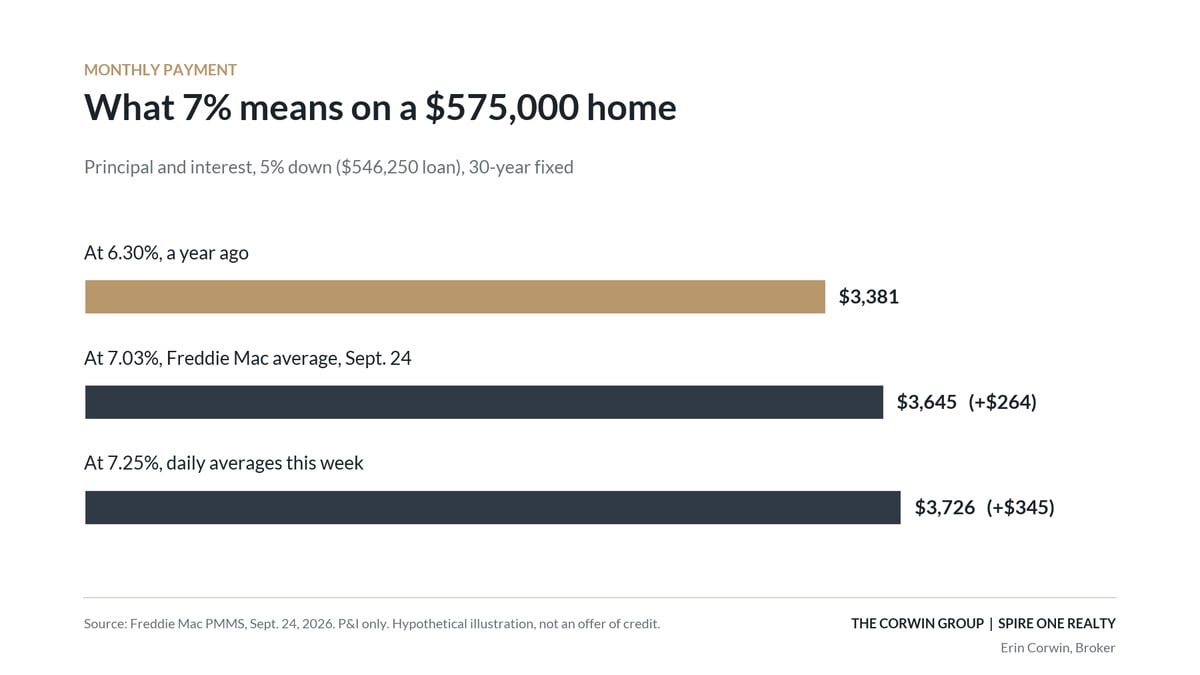
That is roughly $260 to $345 more per month than a year ago, before taxes, insurance and mortgage insurance. It is real money, but it is also a gap that can often be closed. Here is how.
What it takes to close a $200 to $300 gap
So how much would a seller have to give up to erase that increase? It depends on how the money is used.
- To close a $200 gap: about a $31,500 price reduction (5.5% of price), or about a $12,000 seller-paid permanent rate buydown (2.1% of price)
- To close a $264 gap (back to last year's rate): about a $41,600 price reduction (7.2%), or about a $15,900 buydown (2.8%)
- To close a $300 gap: about a $47,300 price reduction (8.2%), or about an $18,200 buydown (3.2%)
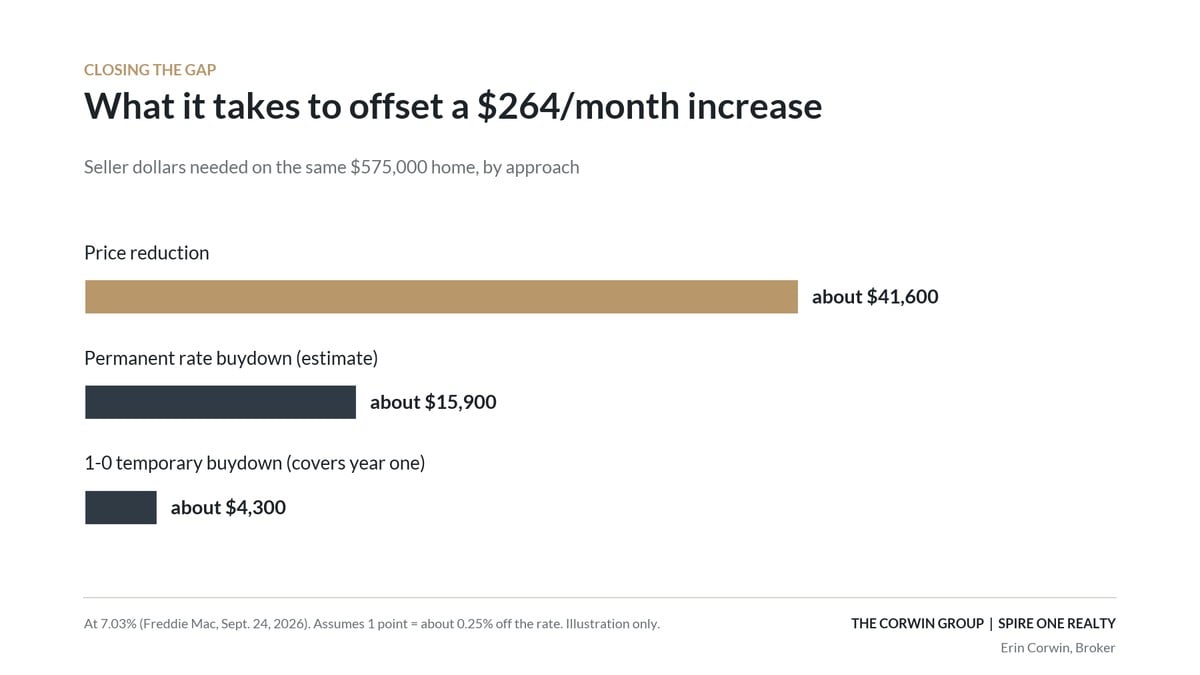
The takeaway: to lower the buyer's payment, a dollar spent on the rate does roughly two and a half times the work of a dollar taken off the price. Each $1,000 off the price saves this buyer only about $6 a month.
A temporary buydown costs even less up front. A 1-0 buydown (1% lower for year one) runs about $4,300 and more than covers the gap for the first year. A 2-1 buydown runs about $12,750 and covers the first two years, with room to spare.
Buydown estimates assume one point (1% of the loan) buys about 0.25% off the rate. Actual pricing changes daily and varies by lender. On a conventional loan with 5% down, seller contributions are generally capped at 3% of the price ($17,250 here), so the $200 and $264 buydowns fit within that limit and the $300 one runs just over it.
Paths forward for buyers
1. Ask for a seller credit, and use it on the rate
This is the most powerful tool on the table right now, and the numbers show why. On that same $575,000 home, a 3% seller credit is $17,250. Here are two ways to spend it:
- As a price reduction: the payment drops by about $109 a month.
- As a 2-1 temporary buydown: the rate is cut by 2% in year one and 1% in year two. The payment drops by about $703 a month in year one and $360 a month in year two. The buydown costs about $12,750, leaving roughly $4,500 for closing costs.
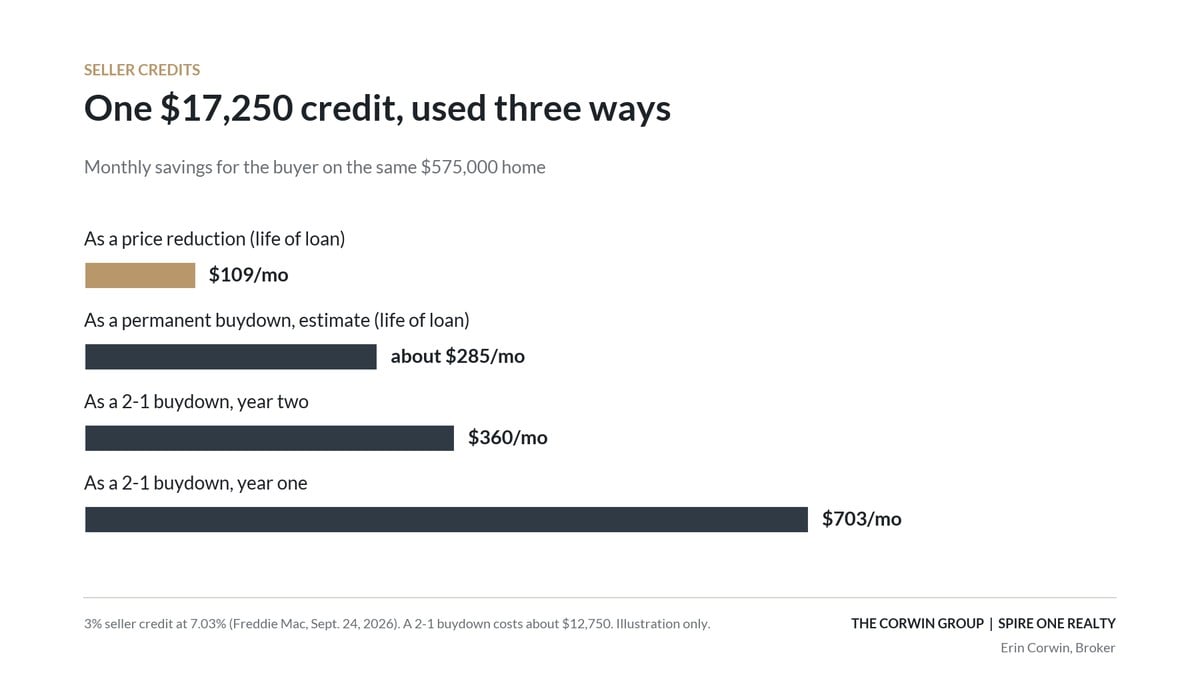
Same dollars from the seller, very different results for the buyer. A permanent buydown (paying points to lower the rate for the life of the loan) is another option, and a lender can price both. One caveat: with a temporary buydown, buyers still qualify at the full note rate, so it helps cash flow in the early years rather than purchasing power. If rates fall later, a refinance can replace it.
How much a seller can contribute depends on the loan. As a general guide, FHA allows up to 6% of the price, VA allows 4% in concessions (on top of normal closing costs), and conventional loans allow 3% to 9% depending on the down payment. Your lender will confirm the exact limit.
2. Look at a different loan product
Buyers are already doing this. In the Mortgage Bankers Association's weekly survey, adjustable-rate loans rose to 9.8% of applications for the week ending September 18, up from 8.0% three weeks earlier. FHA loans made up 16.7% of applications and VA loans 12.0%.
- FHA allows as little as 3.5% down and more flexible credit guidelines. MBA's survey put the average FHA rate at 6.78%, versus 7.12% for a conventional 30-year, though FHA mortgage insurance needs to be part of the comparison.
- VA loans offer zero down for eligible veterans and service members, with no monthly mortgage insurance.
- Adjustable-rate mortgages start with a lower fixed rate for five, seven or ten years. They can make sense for buyers who expect to move or refinance within that window, as long as they understand what happens after.
3. Rethink the down payment
A bigger down payment lowers the loan and the payment. A smaller one keeps cash in the bank for reserves, repairs or a future refinance. There is no single right answer. It depends on the buyer's savings, plans and comfort level. And for buyers who are short on cash, Washington's down payment assistance can close the gap (more on that below, and in the next post in this series).
4. Take over the seller's low-rate loan
FHA and VA loans can generally be assumed by a qualified buyer, with the lender's approval. That means stepping into the seller's existing rate, which could be in the 3s or even the 2s. For perspective, a $400,000 loan at 3.5% carries about $1,796 a month in principal and interest, compared with $2,669 at 7.03%.
The catch: the buyer has to cover the difference between the loan balance and the price, in cash or with a second loan. Assumptions also take longer to process. For VA sellers, entitlement can stay tied to the loan unless the buyer is an eligible veteran who substitutes theirs.
5. Consider seller financing
Seller financing is one of the most overlooked tools in a higher-rate market. It can take two shapes:
- The seller carries the whole loan. Sellers who own their home free and clear can act as the lender, with the buyer making payments to them instead of a bank.
- The seller carries a smaller piece. The buyer gets a traditional first mortgage, and the seller carries a smaller second loan to cover part of the difference between the bank loan and the price. That can reduce the buyer's down payment or the size of the bank loan. Whether and how a seller second works depends on the buyer's loan program (conventional loans are the most flexible), so the buyer's lender needs to sign off on the terms up front.
The rate, down payment, term and any balloon date are all negotiable, which gives both sides room to find terms that work. For buyers, it can mean a rate or a structure a bank won't offer. For sellers, it can mean monthly income with interest, and a home that stands out from everything else on the market. Seller financing can be written using standard Northwest MLS financing forms, and I can walk you through how the terms fit together. Sellers will also want to talk with their tax advisor about how payments over time affect their situation.
What this means for sellers
Buyers have more homes to choose from than they did a year ago, but higher rates have made it harder for many of them to say yes. Northwest MLS's August numbers show both sides: more listings on the market, and fewer sales closing. Here is August 2026 compared with August 2025:
- Active listings: 24,675, up 22.0%
- Closed sales: 5,861, down 7.6%
- Median sale price: $635,000, down 2.3%
- Months of inventory: 4.21, up from 3.19
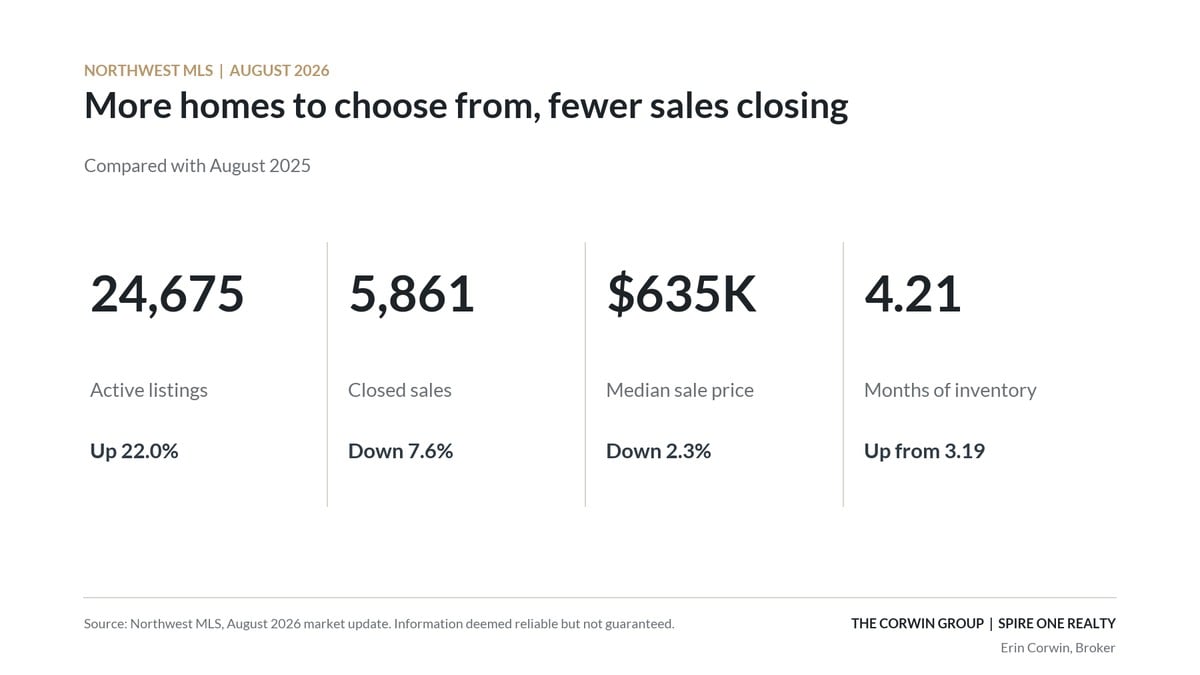
For sellers, that means the buyers who are out there are serious, rate-sensitive and comparing options. The sellers who sell are the ones who meet them where they are.
- Think payment, not just price. As the buydown example above shows, a credit toward the buyer's rate can do far more for their monthly payment than the same dollars off the price. It can also protect your sale price, which matters for your bottom line and for neighborhood comps.
- Know what you're sitting on. If you have an FHA or VA loan at a low rate, assumability can be a real selling point. Ask your lender whether your loan is assumable and what the process looks like.
- If your home is paid off, or nearly so, consider offering terms. Seller financing, whether you carry the full loan or a smaller second, can set your home apart from every other listing competing for the same buyers.
- Price for today's market. With more inventory, homes that start at the right price and show well are still moving. Homes that test the market tend to sit.
- Be open to assistance buyers. Most homes that sold through NWMLS last year were eligible for down payment assistance. Offers from buyers using these programs are standard, well-established financing, not a red flag.
A word on down payment assistance
If cash to close is the hurdle, Washington's state-backed assistance is worth a close look. Of the houses sold through Northwest MLS in 2025, over 74% were eligible for at least one down payment assistance program, and 86% of condos. The Washington State Housing Finance Commission's main program, Home Advantage, offers 3% to 5% of the loan amount at 0% interest, with no monthly payment, for households earning under $215,000. First-time buyer status is not required.
One thing to know going in: assistance solves the cash problem, not the payment problem, and it is repaid when the home is sold or refinanced. That is why it pairs so well with a seller-paid buydown. The full program-by-program guide is the next post in this series.
Finding the path forward
Sellers want to sell. Buyers want to buy. Higher rates don't change that. They change the math, and the math has more options than most people realize.
If you're buying:
- Talk to a lender about more than one loan product, and ask them to price a buydown alongside a standard fixed rate.
- Take the free Commission homebuyer education class now. It is required for assistance, and the certificate is good for two years.
- Let your offer strategy do some of the work. A request for a seller credit can be worth more than a lower price.
If you're selling:
- Find out whether your current loan is assumable, or whether you're in a position to offer seller financing.
- Price for today's inventory, not last spring's.
- Be ready to talk about credits and buydowns, not just price.
Let's map out your next move
Thinking about selling? Let's sit down and look at how your home is positioned in today's market: how it compares with the competition, what buyers in your price range can afford at current rates, and which tools, from a buydown credit to assumable or seller financing, could help you sell with the strongest net result.
Thinking about buying? Let's figure out what today's rates mean for your budget, connect you with lenders who know these programs well, and build an offer strategy that puts seller credits, buydowns and assistance to work for you.
I work with buyers and sellers in Snohomish, King, Pierce, Island, Kitsap and surrounding counties. Reach out to set up a no-pressure conversation about your options.
Coming up next in this series: a complete guide to Washington down payment assistance, rate buydowns explained, FHA vs. VA vs. conventional loans, how assumable mortgages actually work, and seller financing in Washington.
Sources
- Freddie Mac Primary Mortgage Market Survey, September 24, 2026
- Mortgage Bankers Association: Weekly Mortgage Applications Survey, September 23, 2026
- Mortgage Bankers Association: Average Mortgage Application Rates
- Northwest MLS: August 2026 Market Update
- Northwest MLS: Homes Eligible for the Down Payment Resource Program, May 26, 2026
- Washington State Housing Finance Commission: Downpayment Assistance Programs
- Washington State Housing Finance Commission: First Mortgage Programs
- Forbes Advisor: Mortgage Rates Today, September 28, 2026
Important information
Information deemed reliable but not guaranteed. This article is for general educational purposes only and is not legal, tax, financial or lending advice. Every buyer's and seller's circumstances are unique, and the options described here may not be available or appropriate for your situation. Please consult a licensed mortgage professional, tax advisor or attorney about your specific circumstances before making decisions.
Payment examples are hypothetical illustrations, not an advertisement, offer of credit or commitment to lend. They assume a 30-year fixed-rate loan repaid in 360 monthly payments and show principal and interest only. They do not include property taxes, homeowners insurance, mortgage insurance, HOA dues or other costs, which would increase the actual payment. Rates shown are published national averages, not any lender's pricing. They are interest rates, not annual percentage rates (APR); an APR includes fees and would be higher. Assuming prepaid finance charges of 1% of the loan amount ($5,463), the corresponding annual percentage rates (APR) would be approximately 6.40% at 6.30%, 7.13% at 7.03%, and 7.35% at 7.25%. These APRs do not include mortgage insurance, which would raise the APR on loans with less than 20% down. Actual rates, APRs, fees, loan limits, program terms and seller contribution limits vary by lender, borrower credit and property, and change frequently. Erin Corwin is a real estate broker, not a mortgage lender or loan originator, and does not receive compensation for lender referrals.
Market statistics are based on data reported by Northwest Multiple Listing Service and the other sources listed above, and are subject to revision. Down payment assistance programs are administered by the Washington State Housing Finance Commission, and eligibility is determined by the program and participating lenders.
Erin Corwin, Broker | The Corwin Group at Spire One Realty | Equal Housing Opportunity
206-650-7390
